← All Projects
Game Design Scream Jam 2026 · Godot 4.7

Scrapped Horror Game

For Scream Jam 2026 I designed a first-person horror game about the last human alive on a frozen, sunless Earth, crawling between heated habitats while monsters hunt the ice maze outside. Our jam team split up before the game got built. I still wanted to see the monsters in motion, so I set them up in a Godot test scene and filmed each one with the same player input.

Same mistake (breaking cover), four different punishments
Role
Designer: game, enemies, map
Jam
Scream Jam · Oct 16–23, 2026
Engine
Godot 4.7
Clips
4 monsters × stealth and aggro
The roster

Four ghosts, each after something different

Pac-Man's ghosts each run one simple targeting rule, and together those rules produce pincers and ambushes. I kept each ghost's rule and translated it into first-person horror stealth. Three of the four warn you and then go for where you were, so moving is almost always the answer. Blinky is the exception, because you beat it by looking at it.

Ghost Pac-Man rule My rule Takes your Counterplay
Blinky Targets Pac-Man's tile Walks straight to your tile; can't move while you look at it Attention Spend looks on it
Pinky Targets 4 tiles ahead of Pac-Man Every 10 s, moves 10 ft ahead of where you're looking; when it hears you, it screeches and pounces on where you were Route Keep moving after the screech
Inky The unpredictable one Searches at random inside a 20 ft scent circle; pulses tendrils that stop at walls Cover Keep a barricade between you
Clyde Chases when far, retreats when close Approaches past 50 ft, wanders its nest inside it; its horn scatters every monster Information Stay close; scout again after a horn
Same hiding spot, same input, four different patrols

How to read the clips. They start in the debug view. The tag over each monster is its state, the dashed line ending in an ✕ is where it's heading, the yellow wedge is the player's gaze, white rings are footstep noise, and the corner map shows it all from above. Switch to the game view to see it the way a player would. The beam from the visor is where the player is looking, and since the world is monochrome, any colour on screen is a warning.

Every clip uses one of two scripted inputs. In stealth the player stays crouched behind cover. In aggro they break cover at 0:01 and crawl across an open gap.

Blinky

"the statue" Takes your attention

It can only move when you aren't looking at it, and you need your eyes for everything else.

Stealth
Aggro
My rule
Pac-Man's Blinky is the pure chaser. Mine walks straight to your tile once it knows where you are and keeps coming, but it can't move while it's inside your gaze.
The tell
Its walk cycle is tied to distance travelled, so when you look at it, it stops dead mid-stride. The frozen pose is the warning, so it needs no UI.
In the clips
Stealth: at 0:02.6 it walks into the visor beam and freezes. When the visor drops at 0:05 it walks straight past. Aggro: it spots the player at 0:03.5, freezes every time they glance back, and ends in a standoff 3 m away that the player can't hold forever.
Design call
I gave it an unaware patrol so it can be snuck past, because a stealth game needs a window where the player can win. Open question: at 1.6 m/s, does freezing it feel like a choice or a chore?

Pinky

"the cutoff" Takes your route

It's always somewhere in your way, and the moment it hears you, it jumps.

Stealth
Aggro · unmute for the screech
My rule
Pac-Man's Pinky aims four tiles ahead of where Pac-Man is moving. Mine reads where you're looking: every 10 s it moves 10 ft ahead of your gaze. When it hears your footsteps it screeches, and 2.5 s later it lands on the spot where you were.
The tell
The outside world is monochrome, so its warning is colour. The gelatinous cube flushes acid green and magenta, then screeches. That gives you 3.5 s to move.
In the clips
Stealth: it parks 10 ft in front of the player's cover and sits there, in the way, but never attacks a silent player. Aggro: two screeches. The player keeps crawling after the first and it misses at 0:05.2. They stop after the second, and it lands on them at 0:09.1.
Design call
The 10-second reposition keeps steady pressure on your route, and the pounce punishes noise. Open question: is 3.5 s of warning fair without making Pinky harmless?

Inky

"the scout" Takes your cover

It can smell you from twenty feet away but can't pin you down any closer, and its tendrils can't get through walls.

Stealth
Aggro
My rule
Outside 20 ft it follows your scent. Inside 20 ft it can't pinpoint you, so it searches at random. Every 10–30 s it stops and pulses out tendrils exactly like GTFO's Scout, and a tendril stops at the first barricade it touches. Touch one and it charges the point of contact.
The tell
It stops moving to pulse, and the tendrils creep across the snow where you can see them. After a touch it takes 2 s to pull them back in, and that's your window, because the touch only told it where you were.
In the clips
Stealth: it searches right in front of the player, then pulses, and the tendrils aimed at them stop on the barricade. Aggro: the player crawls into a tendril in the open at 0:03.5. Inky charges at 0:05.5 and arrives to find them 4 m further down the corridor.
Design call
It charges the spot it touched rather than the player, so getting touched is a warning you can still escape. Open question: are 10–15 s tendrils slow enough to read and quick enough to keep the pressure on?

Clyde

"the bull" Takes your information

When it blows its horn, every monster on the map moves, and your radar is suddenly out of date.

Stealth
Aggro · watch the corner map
My rule
Farther than 50 ft away, Clyde walks toward you. Inside 50 ft it wanders around its nest. It holds either state for 12.5 s before it can switch. Stay far away for a random 5–50 s and it blows its horn: every monster on the map scatters to a new spot, and Clyde charges where you were standing.
The tell
It rears up and swells for 1.3 s before it charges, and the horn shakes the camera. The bigger cost is that whatever your radar showed you, which you paid batteries for, is now wrong.
In the clips
Stealth: it's already committed to an approach, so it keeps lumbering toward the player's cover until its hold runs out at 0:04.0, then turns back to its nest. Aggro: it blows its horn at 0:03.4, and on the corner map Blinky, Pinky and Inky all scatter.
Design call
Like Pac-Man's Clyde, it's meant to seem random, but it has a brain you can control once you work it out: stay within 50 ft and it stays home. The horn puts it in a different league from the other three, since it moves every monster on the map at once. Open question: does "stay close to Clyde" read without a tutorial?
Design log

The game I designed

Scream Jam is a 7-day horror game jam on itch.io. My design puts the player in the shoes of the last human alive, long after the sun has gone out. The surface is frozen and overrun by monsters that can only survive in the cold, and the player has to cross it between five warm habitats, finishing a checklist of errands before the cold or a monster gets them.

  • Plan a route between habitats. Each one is a warm, safe room with fresh batteries.
  • Cross the frozen ruins while your warmth meter drains, using a battery-powered radar to spot the monsters.
  • Carry items between habitats to finish the checklist: carrots to the pigs, a corpse to the biodiesel plant, oil to the generator, flowers to a grave.
  • Get back to the first habitat alive.

Gravedigger

The first pitch was a first-person grave robber. Dig up a body, loot it, and its ghost rises with a favor to ask, like the Wayward Spirit favors in God of War (2018). Finish the favor and the ghost passes on. Ignore it and it escalates through phases: harmless, then a wandering zombie, then a Weeping Angel that only moves when you look away, then a "doorman" that drops you into a maze copy of the graveyard underground, and finally it kills you.

I listed five candidate favor types, to be trimmed to three. Looting borrowed R.E.P.O.'s levitating carry: one item at a time, stashed in a pile and wheeled out at the end of the night, so it feels like real grave robbing instead of an inventory screen. I looked at Risk of Rain 2's difficulty meter as a model for difficulty that climbs the longer you stay. I also wrote down the questions I hadn't answered yet, like whether digging should take time (more pressure, and room for upgrades) or be instant (so it never turns into a farming sim).

Core Loop Escalation Open Questions

Scrapped horror game

The second revision moved to a frozen, sunless Earth. The player lives on a space station and comes down once a week for supplies, so the surface always feels like unknown territory. Two resources carry the tension: a cold meter that runs down outside the safe zones, and a radar that shows nearby monsters as blips but runs on batteries. Batteries can go from warm to frozen but not back, so the player gets fresh ones at every habitat. That gives me exact control over how much radar time the player has on each trip, and I expected it to be the decision players think about most.

The four ghosts come from this revision. I built each one on a Pac-Man ghost and its targeting rule: Blinky freezes while you look at it, Pinky cuts off your route, Inky is blind and works by scent and tendrils, and Clyde's real job is to make the player's radar go stale. The roster at the top of this page is this revision.

Resource Tension Enemy AI Pac-Man Ghosts

One enemy, one map

Revision 3 opens with two scope rules for a 7-day jam: one enemy, and one map with several key locations instead of several small maps. I cut three of the four ghosts and kept Inky. Its tendrils extend over 10–15 seconds, hold for about 5, retract over 5–10, and stop at any barrier, so the player has two ways out: keep a wall between you and it, or stay out of range. The player stays crouched the whole time, moving slowly, and every step crunches in the snow.

The rest of the doc is written for the people building it. It lays out the tutorial beat by beat, from an Undertale-style opening crawl to a scripted death the first time the player steps outside, which teaches that this game is about escaping. Respawning unlocks the radar. Every habitat follows one template (airlock door, its station's machine, a chair to wait out the monster, no windows, a map on the wall, a battery shelf), and each habitat gets a section listing what you can interact with.

I drew the map by hand. The short lines are the ice-covered remains of building walls, which double as cover. The yellow rooms are the five habitats, #1 is a statue landmark, and #2 is a nest piled with bones.
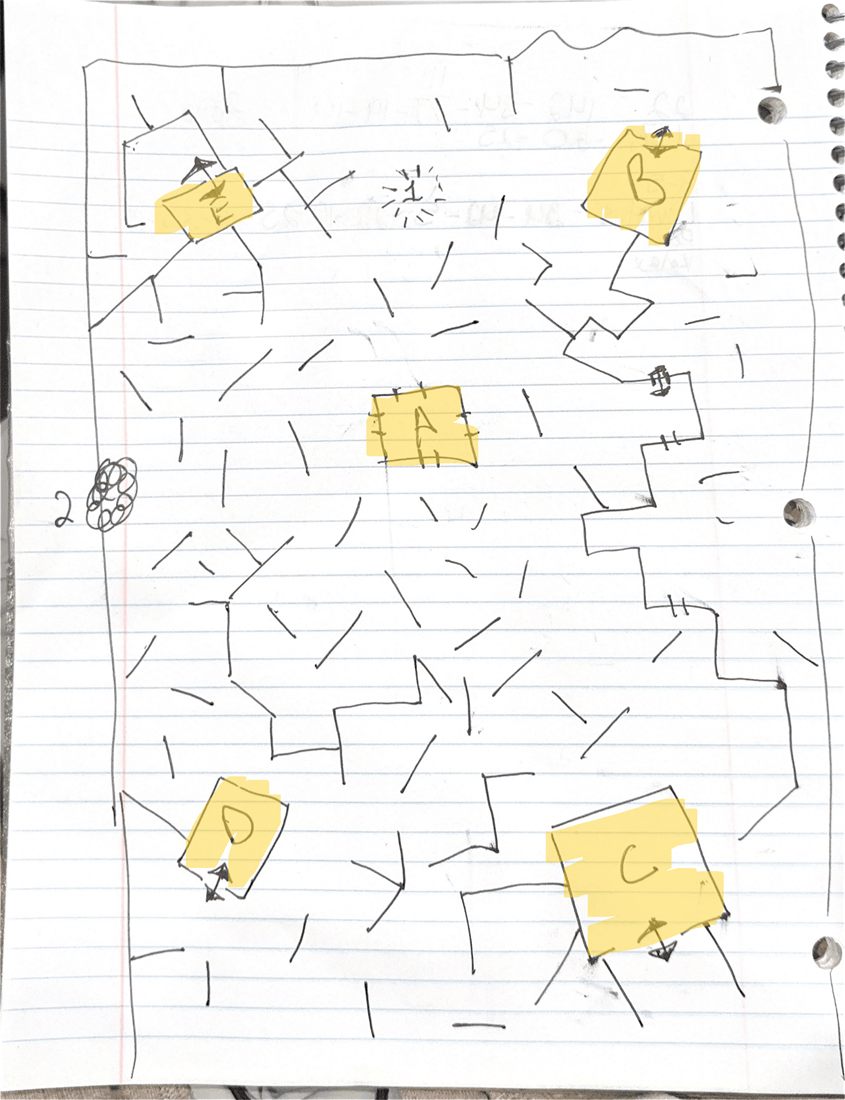
Hand-drawn top-down map on notebook paper: five habitats labeled A to E highlighted in yellow, scattered short wall segments between them, a statue marked 1, and a nest marked 2
Scope Cutting Level Design Tutorial Design
Building it

If I built it again

I built these clips with Claude Code, working from my design docs. For a portfolio piece that made sense. The design was already done, and I wanted to see my rules running and get them in front of people quickly. For the real game I would split the work differently.

  • I'd write the four state machines myself in GDScript. The enemy behaviour is the design here, and tuning it well means knowing that code inside out. It's the same kind of work I did by hand on Tails of the Tower, where I built the slime, the archer and the Hob Lobber.
  • I'd still use AI for the support code around the game, like the capture setup, the debug overlay and the render scripts.
  • I'd put the open questions above in front of real players before changing any numbers.

More on how I use AI coding tools →